
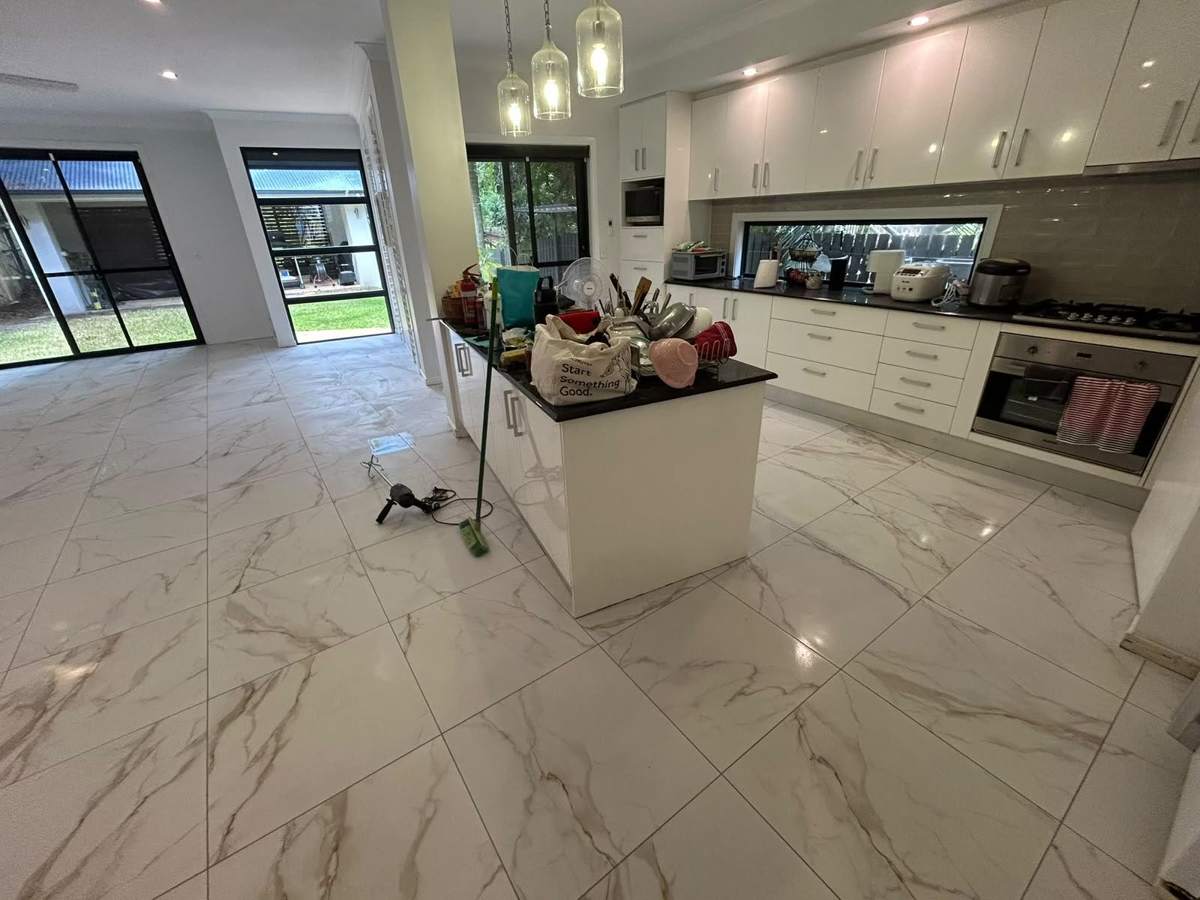
Large-format tiles have become a favourite for open-plan homes. Fewer grout lines make a room feel bigger and cleaner. But a big tile is less forgiving than a small one, and the way it is laid matters as much as the tile you choose. This guide covers what to think about before you buy.
What counts as large format?
There is no strict rule, but tiles from around 600 mm on a side are usually called large format. Many floors in new homes use 600 by 600, 600 by 1200 or even bigger slabs. Larger tiles show fewer joints, which gives a calmer look across a living area.
The floor underneath has to be flat
A small tile can follow a slightly uneven floor. A large one cannot. A big tile bridges high and low spots, which means one corner can sit proud of its neighbour. This is called lippage, and it is the most common complaint with large-format floors.
Before tiling, the floor needs to be checked with a long straight edge. High spots may need grinding and low spots may need levelling compound. This prep is not the glamorous part of the job, but it decides how the finished floor looks.
Adhesive and coverage
Large tiles need full contact with the adhesive. If there are gaps under the tile, it can sound hollow and it may crack under load. Tilers usually spread adhesive on the floor and also on the back of the tile, a method called back-buttering, so the tile beds in with no voids. The adhesive needs to suit the tile type and size, and the product label will say what it is rated for.
Choosing the finish
Tiles come in polished, matt and textured finishes.
- Polished tiles look bright and show the veining on marble-look designs, but they can be slippery when wet and show marks.
- Matt tiles hide marks and are a more practical choice for busy kitchens and living areas.
- Textured tiles give more grip and suit outdoor areas, but they are harder to clean.
For wet areas, ask about slip resistance. In Australia, slip resistance for pedestrian surfaces is classified under AS 4586, and the supplier should be able to tell you the rating for each tile.
Marble-look and stone-look porcelain
Porcelain printed to look like marble or stone is one of the most popular choices. It gives you the look of stone without the sealing and upkeep. With veined designs, tiles are made in a range of patterns, so it is worth looking at several tiles from the box laid side by side before you commit.
Grout lines
Large-format tiles are often laid with narrow grout joints. A narrow joint looks sleek, but tiles are not perfectly square and a very tight joint can show every small variation. A slightly wider joint is more forgiving and gives the tiles room to move. Grout colour also changes the look. A grout that matches the tile makes the floor look seamless, while a contrast colour outlines each tile.
Movement joints
Large floors move. They expand and contract with temperature and the building itself moves a little. Movement joints, which are flexible gaps filled with sealant, are used at the edges and across large floors so that the tiles do not crack. Your tiler can plan where these should go.
Order extra
Always order more tiles than the floor area. Cuts at walls, doorways and corners waste tile, and some tiles break. A common allowance is around 10 percent, and it can be higher for large tiles or diagonal layouts. It is also worth keeping a few spare tiles for future repairs, because the same pattern may not be available later.
Planning the layout
Before tiling begins, the layout should be planned so that cuts at the edges are not thin slivers and so the joints line up with doorways and features. In a large open-plan room, the starting point is usually chosen so the main sight lines look right. This is something we do before opening the first box.
Thinking about your whole home
If the same tile will run from the kitchen into the living area and hallway, think about how it will look in different light. Large glossy tiles reflect windows and downlights, so a floor that looks soft in the showroom can look very bright at midday. Matt and satin finishes reduce glare and hide footprints, which helps in a house with kids, pets or a lot of foot traffic.
Think about transitions, too. Where the tiled floor meets timber, carpet or an outdoor area, the heights need to match or be finished with a neat edge. Decide on these before the tiles arrive, not after the floor is laid. It is much easier to plan a threshold than to fix one.
Questions to ask before you buy
- Is this tile rectified, meaning cut to a precise edge?
- What is the slip rating?
- What adhesive and grout does the supplier recommend?
- How much extra should I order?
- Does the floor need levelling first?
Talk to us
If you are planning a floor, call Brisbane Wall and Floor Tiling on 0406 482 001 or send an enquiry. We lay large-format floors across Brisbane, Logan, the Gold Coast, Ipswich and Redland Bay.
Related Services and Areas
See our Floor Tiling page, or browse all services. We work in Daisy Hill, Brisbane CBD, Ipswich, Redland Bay and across the Gold Coast. Call 0406 482 001 or send an enquiry.