Marble has a look that is hard to beat. Soft veining, bright colour and a polished surface make a room feel high end. Today there is a second option: porcelain tiles printed to look like marble. Both can look beautiful, but they behave very differently once they are installed. This guide compares them.
What each one is
Natural marble is a stone cut from the ground. No two slabs are the same, and the veining runs through the stone.
Marble-look porcelain is a manufactured tile made from fired clay, with a pattern printed or pressed on the surface. Good tiles have a wide range of patterns so a floor does not repeat too obviously.
Upkeep
Natural marble is a soft, porous stone. It can stain from wine, oil, coffee and acidic products. Acidic cleaners can dull the surface in a process called etching. Most marble needs sealing when it is installed and again over time.
Porcelain is dense and does not absorb water in the same way. It does not need sealing and it is not affected by common household cleaners. For a busy family kitchen, this makes porcelain far easier to live with.
Look and feel
Natural marble has depth. The veining is part of the stone and changes as light moves across it. Porcelain looks very convincing at a normal viewing distance, and the best tiles are hard to tell apart from the real thing. Up close, a print can look flatter and repeat patterns may be noticeable.
If authenticity matters most to you, natural marble wins. If you want the look with fewer worries, porcelain is a strong choice.
Wet areas
In showers, marble-look porcelain is popular because it does not stain from soap and shampoo and it does not need sealing. Natural marble can be used in showers, but it needs more care, careful waterproofing and regular maintenance.
Slip resistance is another consideration. A polished tile of either type can be slippery when wet. For shower floors, a matt or textured finish or small tiles with more grout lines give better grip. Ask the supplier for the slip rating of any floor tile.
Floors in living areas
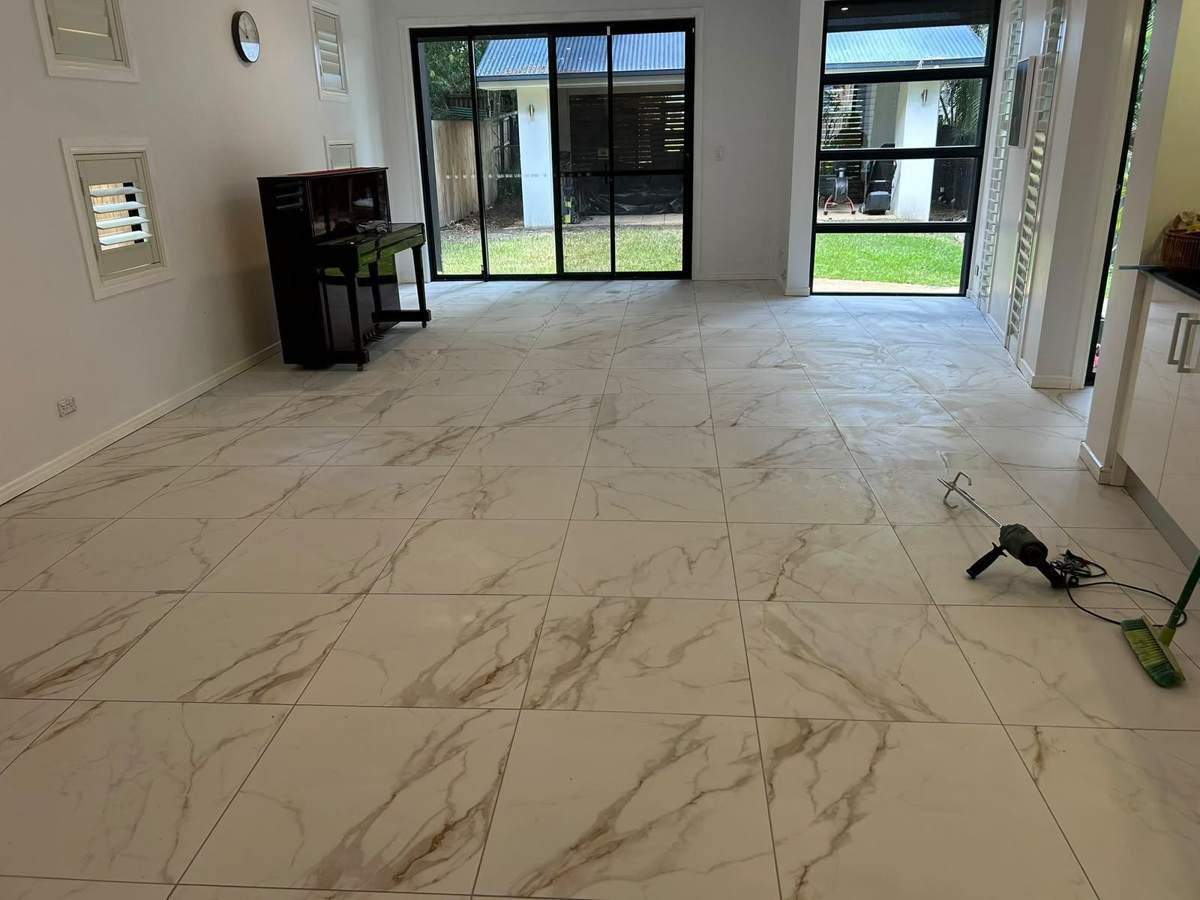
Large marble-look porcelain tiles, often 600 by 1200 or larger, are a common choice for open-plan living areas. You can see this kind of floor in many of our job photos. The look is bright and continuous, and the surface is hard-wearing.
Natural marble floors need careful installation. The stone is more fragile and can crack if the floor underneath is not rigid or flat, and it can scratch more easily.
Weight and handling
Large slabs of either material are heavy. Natural stone slabs can be heavier, and they need careful handling during installation. Large porcelain tiles are also heavy and need two people to move safely on site.
Installation
Both need a flat floor and good adhesive coverage. Marble is more sensitive to the adhesive and grout used, because some products can stain light-coloured stone. Porcelain is less fussy, but the adhesive still needs to suit large tiles.
Natural marble also needs sealing after it is grouted. Grout colour should be chosen carefully, because dark grout can stain light stone.
Cost
The tile and the installation both affect cost. Natural marble is usually more expensive per square metre than porcelain, and the installation takes longer because of the sealing and extra care. We do not quote costs in articles because they depend on the tile, the size of the job and the prep. Call us and we will talk it through.
How to choose
Choose natural marble if:
- You want the real stone and accept the upkeep
- The area is low traffic, such as a feature wall or a powder room
Choose marble-look porcelain if:
- The area is a busy kitchen, living area or family bathroom
- You want a low-maintenance floor that does not need sealing
See a sample first
Whichever you choose, look at a large sample or several tiles from the same batch before you buy. Look at them in the room where they will be used, in daylight and at night.
Lighting and the finished look
Polished marble-look tiles reflect light, which can brighten a room but also show glare from windows and downlights. If your floor gets strong afternoon sun, consider a satin or matt finish. In a bathroom with a feature wall, a polished tile behind a bath can look striking, especially with soft lighting from above.
Matching with other finishes
Marble-look tiles work well with timber, matt black tapware and white cabinetry. Warm greys and creamy veins suit natural timber, while cool white and grey marble suits a crisp, modern bathroom. Bring a sample of the tile when you choose tapware and vanities so you can see them together.
Talk to us
If you are deciding between marble, marble-look porcelain and other stone-look tiles, call Brisbane Wall and Floor Tiling on 0406 482 001 or send an enquiry. We work across Brisbane, Logan, the Gold Coast, Ipswich and Redland Bay.
Related Services and Areas
See our Stone Tiling and Cladding page, or browse all services. We work in Daisy Hill, Brisbane CBD, Ipswich, Redland Bay and across the Gold Coast. Call 0406 482 001 or send an enquiry.